
Osteoarthritis, meniscus problems, hip pain, back pain or an old injury: Ski-Mojo helps many skiers relieve pressure on their joints and enjoy longer ski days, with less effort and more confidence.
Ski-Mojo is available to try at more than 550 partner retailers, both in ski resorts and in town.
You are not alone.
These are the things we hear most often from skiers who contact us, whether they are dealing with knee, hip or back pain.
Skiing places repeated and significant stress on the knees, hips and lower back, especially at the end of the day, when muscles become tired and joints absorb more of the load.
Part of this load can be mechanically reduced, without changing the way you ski or requiring any particular learning effort.
That is exactly what Ski-Mojo does: it is a wearable device that takes part of the body weight normally supported by your joints, helping you ski for longer and with greater comfort.
Designed and made in France, Ski-Mojo is a 100% mechanical system, with no battery and no electronics. You wear it either over or under your ski clothing.
It acts like an external shock absorber: with every flexion movement, it absorbs and returns part of the energy, reducing the effort placed on your legs and knees by 20 to 40 kg, depending on the chosen setting.
The benefits are not limited to the knees. By absorbing part of the shocks and vibrations, while supporting the skier’s natural movements, Ski-Mojo can also help relieve the hips and lower back, which are increasingly stressed throughout the day.
The pain is not masked or moved elsewhere: the causes that trigger the pain are reduced. The result? Fresher legs, smoother movements and ski days you can enjoy for longer.
Many users describe it very simply: the feeling of getting back the legs they thought they had lost.
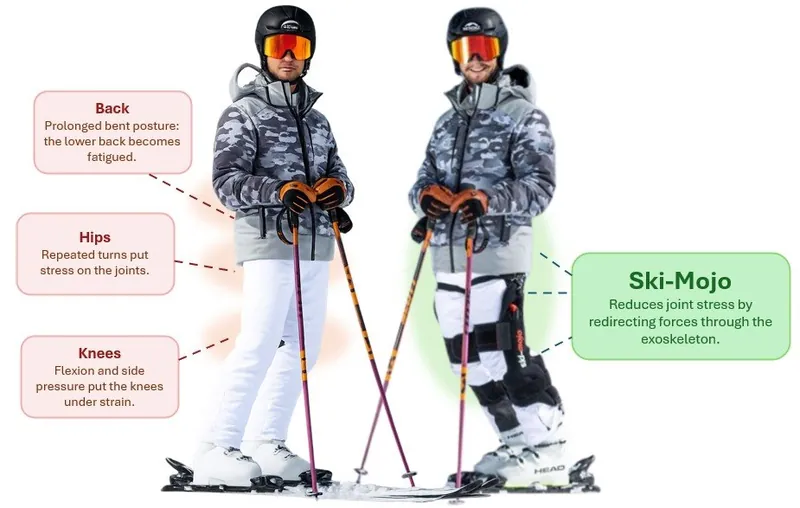
Less joint fatigue
Your knees, hips and back are less stressed with every turn, especially at the end of the day.
Greater endurance
Many skiers report being able to ski more runs without feeling the same heaviness in their legs.
More confidence in turns
A greater feeling of stability, especially on hard snow or at the end of the season.
Less apprehension
Skiing without fearing the evening pain changes the whole experience of the day.
Easier recovery
Less joint stress during effort means fewer aches the next day.
The joy of skiing with family or friends
Keep skiing with your family or friends, at your own pace, without feeling like you are holding the group back.
Ski-Mojo is used by a wide variety of skiers. Here are the most common situations among our users.
Skiing with knee osteoarthritis
Osteoarthritis causes wear of the cartilage, making each flexion movement more painful, especially at the end of the day.
By reducing the load supported by the joint and absorbing a large part of the shocks and vibrations travelling up through the legs, Ski-Mojo can help you keep skiing for longer and with greater comfort, even in cases of advanced osteoarthritis.
Skiing with a damaged or operated meniscus
A meniscus injury, whether operated or not, weakens the knee under twisting and bending movements — two movements that are constantly involved in skiing.
By reducing the pressure placed on the joint, Ski-Mojo can help limit the strain that triggers pain again.
Skiing with a torn or weakened cruciate ligament
Whether operated or not, an anterior cruciate ligament injury weakens knee stability and increases the risk of further injury.
By reducing stress on the joint and lowering quadriceps contraction, Ski-Mojo helps reduce pain and relieve a weakened knee, without ever restricting freedom of movement.
Skiing with a knee replacement, before or after surgery
Before surgery, Ski-Mojo allows some skiers to continue skiing for longer before considering a knee replacement.
After surgery, once the knee replacement has been fitted and your rehabilitation has been approved by your surgeon, Ski-Mojo can help some skiers return to skiing more comfortably by reducing the load felt with every turn.
Skiing after 60
With age, muscle recovery becomes slower and fatigue sets in more quickly.
Ski-Mojo helps prolong the pleasure of skiing by delaying the onset of fatigue. And whatever your age, skiing with less tired legs helps you maintain better balance, stronger support and better control of your line for longer, which may help reduce the risk of falls and injury.
Please note that Ski-Mojo will not make you ski faster. However, by taking fewer breaks and feeling more precise on your skis, you can make the most of your ski days and maximise your time on the slopes, with even greater enjoyment. Your technique may also improve thanks to the effect of the system on your posture, with the pelvis positioned further forward and a more centred stance, and thanks to delayed fatigue, as the springs act like “extra quadriceps”.
This information is provided for guidance only and does not replace medical advice. If you have a diagnosed condition, have recently had surgery or have any doubt about your ability to ski, please seek advice from your doctor, surgeon or physiotherapist before skiing.
These devices do not meet the same need and are often complementary rather than competing solutions.
Main function
Effect on fatigue
Combined use
Prescription
If you already wear a knee brace, you do not need to remove it to use Ski-Mojo. It will provide additional stability for your knee.
Want to know whether Ski-Mojo could help you? The easiest way is to try it on snow at one of our partner stores.
Survey conducted in 2026 among 3,973 Ski-Mojo users: 91% overall satisfaction, 99% report reduced knee pain, 94% reduced back pain, and 93% reduced hip pain.
“Very quickly, once you get used to Ski-Mojo, you feel support throughout the anterior muscle chain. The quadriceps work less. The knees are under less strain and you feel as if you weigh 20 kg less. For patellofemoral syndromes and kneecap problems, this device is of great interest. The same is probably true for more advanced osteoarthritis.
I also see a benefit during recovery, particularly after knee replacement surgery, where this device can help regain quadriceps strength and muscle tone, while also reducing wear on the prosthesis and limiting the risk of loosening.”
Dr Patrice Manopoulos
Orthopaedic surgeon
“As part of a study carried out in our biomechanics laboratory, we found that Ski-Mojo allows the quadriceps to function at 70% of their reference activity while engaging the hamstrings more. These muscles are too often neglected in skiers’ physical preparation, yet they contribute to preventing knee sprains.
This device also makes it possible to increase exercise duration and therefore to strengthen users’ legs in a gentler and more progressive way. We are looking at a true revolution in lower-limb safety for skiing.”
Eric De Gunsch
Physiotherapist
“It is not a gadget. It genuinely relieves the quadriceps and knees without you even noticing. And it is great to be able to activate or deactivate it whenever you want, even though its incredible support makes you want to use it on every run.”
Pierre-Emmanuel Dalcin
World Cup athlete
“After a one-day trial, I adopted it for my own personal use. My usual pain caused by osteoarthritis, made worse by being slightly overweight, disappeared despite a longer and more intense ski day than usual. It is a huge technical breakthrough.”
Janusz Stelmaszyk
Orthopaedic surgeon
Similar posts
We use cookies to give you the best experience possible. If you don't mind, just click OK. If you'd rather not, you can easily refuse all cookies or manage your preferences.
Due to recent regulatory changes, significant customs duties and import fees may apply to all orders shipped to the United States. These charges may range from 15% to 50% of the order value.
⚠️ These charges are determined by U.S. customs authorities and are therefore not included in the order total or shipping fees.
They are the sole responsibility of the customer and are directly charged by the carrier (typically DHL, FedEx, or UPS) or local authorities upon import. Additionally, due to the current workload of customs authorities, some shipments may be held in customs for several days, beyond our control.
By placing an order, you expressly acknowledge and agree that:
In the event of refusal to pay:
You nevertheless retain your right of withdrawal, in accordance with our Terms and Conditions. However, this right can only be exercised after delivery has been accepted and the goods received, as refusal to accept delivery prevents the return of the goods. Please note that, in the event of exercising your right of withdrawal, you will need to contact the U.S. authorities directly to request any potential refund of the customs duties you have previously paid.
Please note that, alternatively, you can order a Ski-Mojo directly from our US partner, California Ski Company, in Berkeley, CA: www.californiaskicompany.com/
I acknowledge that customs duties (15 to 50%) imposed and collected by the U.S. government may apply and are not included in the order or shipping fees. I agree to pay these charges when requested by the carrier (DHL, FedEx, UPS). I understand that no refund will be issued if I refuse to pay these charges. Failure to pay these charges will therefore result in the loss of your order without refund.
If you do not accept these conditions, your cart will be emptied.
Select your region


